

Project Overview
Lemhi Gold,
Idaho USA
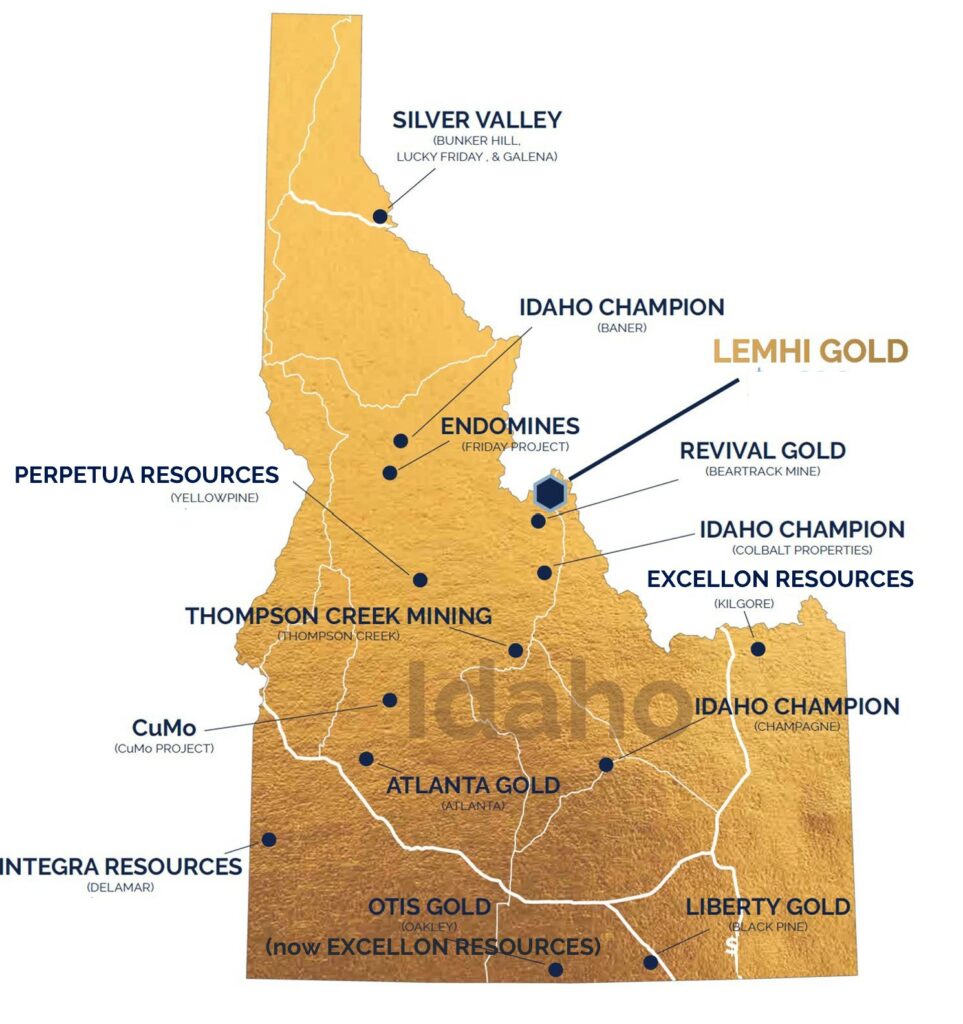
strategically located in the heart of Lemhi County, Idaho
The Lemhi Gold Project is a feasibility-stage oxide gold development project located in Idaho, USA. The project benefits from a combination of strong project economics, a large reserve base, conventional processing methods and a favourable permitting environment within one of North America’s leading mining jurisdictions.
Historical Drilling Intercepts
| 193.55m @ 1.8 g/t Au | 54.96m @ 4.28 g/t Au |
| 179.83m @ 1.81 g/t Au | 152.86m @ 1.06 g/t Au |
| 13.72m @ 15.19 g/t Au | 149.35m @ 1.06 g/t Au |
| 59.44m @ 3.55 g/t Au | 143.26m @ 1.09 g/t Au |
Investment Highlights
- Completed Feasibility Study
- After-tax NPV (5%) of US$696 million
- After-tax IRR of 34.4%
- Initial payback of approximately 2.5 years
- Proven & Probable Mineral Reserves of 1.0 million ounces of gold
- 15.2-year mine life
- Average annual gold production of approximately 75,000 ounces during the first ten years
- Average life-of-mine production of approximately 64,000 ounces per year
- Conventional open pit mining and Carbon-in-Leach processing
- 94.8% metallurgical recovery
- Filtered tailings facility incorporated into project design
- Permitting activities and environmental baseline studies underway
Feasibility Study
The 2026 Feasibility Study confirms Lemhi as a technically robust and economically attractive gold development project.
Base Case Economics
| Metric | Value |
|---|---|
|
After-Tax NPV (5%) |
US$695.6M |
|
After-Tax IRR |
34.4% |
|
Avg. Annual Production (Yrs 1-10) |
75,131 oz |
|
Life of Mine Payable Gold |
971,912 oz |
|
Cash Cost |
US$1,477/oz |
|
AISC |
US$1,718/oz |
The project also offers significant leverage to higher gold prices, with every US$250/oz increase in the gold price adding approximately US$120 million to after-tax NPV.
Mineral Resources & Reserves
The Lemhi deposit hosts a substantial near-surface oxide gold resource supporting a long-life mining operation.
Mineral Reserves
| Category | Tonnes | Grade (g/t Au) | Gold |
|---|---|---|---|
|
Proven |
8,600,000 |
0.85 |
200,000 |
|
Probable |
34,400,000 |
0.71 |
800,000 |
|
Proven + Probable |
43,000,000 |
0.74 |
1,000,000 |
- The Mineral Reserve estimates were prepared by Marc Schulte, P.Eng. (who is also the independent Qualified Person for these Mineral Reserve estimates), reported using the 2014 CIM Definition Standards, and have an effective date of June 10, 2026.
- Mineral Reserves are based on the 2026 Feasibility Study life-of-mine plan.
- Mineral Reserves are mined tonnes and grade, the reference point is the mill feed at the primary crusher and includes consideration for operational modifying factors such as loss and dilution. Estimated ROM quantities and grade are based on measurements within a 4 m x 4 m x 4 m SMU block, with application of an additional 2% mining dilution at 0 g/t Au and a 98% mining recovery.
- Mineral Reserves are reported at an Au grade cut-off of 0.20 g/t.
- Cutoff grade assumes $3,000/oz Au; 99.95% payable gold; $5.00/oz Au offsite costs (refining, transport and insurance); a 2.0% NSR royalty; and uses a 92% low grade metallurgical recovery. The cut-off covers processing costs of $13.00/t, administrative (G&A) costs of $2.75/t and stockpile rehandle costs of $1.50/t.
- Numbers have been rounded as required by reporting guidelines.
The deposit remains open for additional exploration and presents opportunities for future resource growth.
Mining &
Processing
Lemhi is designed as a conventional open pit mining operation utilizing proven processing technology.
Key operating parameters include:
- Conventional truck-and-shovel open pit mining
- Carbon-in-Leach (CIL) processing plant
- Average mill throughput of approximately 2.84 million tonnes per year
- Average head grade of 0.74 g/t gold
- Average gold recovery of 94.8%
- Total payable production of approximately 972,000 ounces over the mine life
The Feasibility Study also incorporates an additional stage of crushing to maximize metallurgical recovery while maintaining a conventional, low-risk processing flowsheet.
Following completion of the 2026 Feasibility Study, Lemhi has demonstrated the potential to become a long-life, low technical risk gold producer with substantial exposure to rising gold prices.
Filtered Tailings
The project incorporates filtered tailings storage into the mine design.
This approach is intended to reduce the project’s environmental footprint while supporting permitting and long-term operational performance through improved water management and a modern tailings storage strategy.
Infrastructure & Location
Located in Idaho, the project benefits from access to an established mining jurisdiction with existing infrastructure, skilled labour and a supportive regulatory framework.
Additional project advantages include:
- Predominantly private patented land
- Existing water rights
- Established transportation access
- Nearby mining workforce and services
Path to
Production
The project is progressing through a defined development pathway:
Feasibility Study completed (2026)
Environmental baseline studies underway
Federal permitting engagement initiated
Mine Plan of Operations targeted for submission
Construction decision targeted following receipt of permits
First gold production targeted in 2031
Why
Lemhi
Lemhi combines strong project economics with a sizeable reserve base, conventional processing, modern engineering and a clear development pathway. The project’s location in Idaho, use of filtered tailings and significant leverage to higher gold prices position it as one of the more compelling undeveloped oxide gold projects in North America.
